Why One Person Chases and the Other Pulls Away
One person texts more to feel close. The other replies less to feel safe. Each move makes the other's stronger, and the thread tightens into a loop both people end up feeling unseen inside. This is the anxious-avoidant cycle, and texting is where it plays out most because a delay reads as distance even when it isn't. Here is the framework, an honest look at both sides of it, and the ways the loop actually eases.
ReadBeneath editorialUpdated 2026-07-25
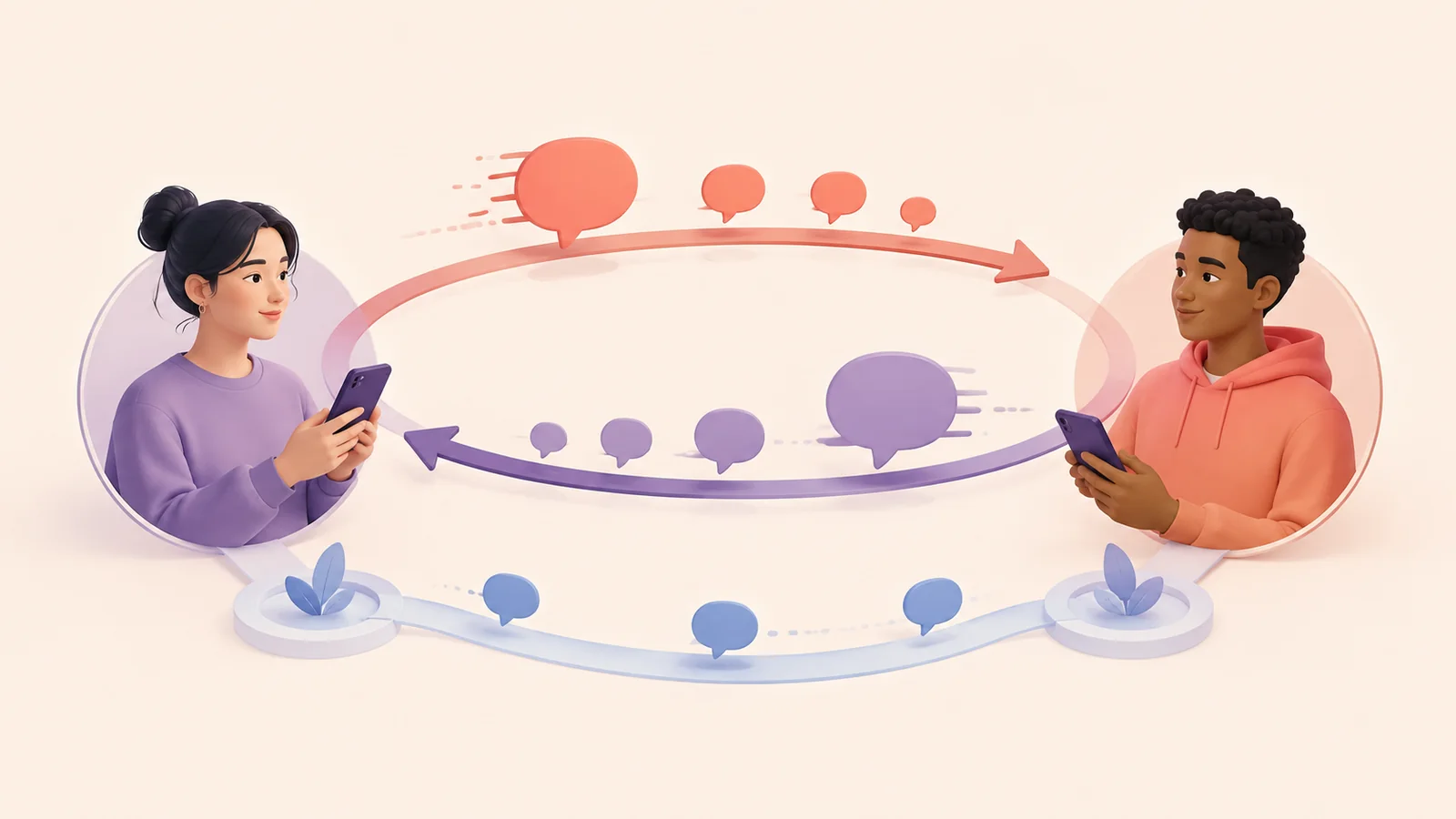
What is the anxious-avoidant cycle?
The anxious-avoidant cycle is a self-reinforcing loop between two attachment tendencies. It grows out of attachment theory, first developed by John Bowlby and Mary Ainsworth and later extended to adult romance by psychologists Cindy Hazan and Phillip Shaver in 1987. Someone leaning anxious is wired to seek closeness and reassurance when they sense distance. Someone leaning avoidant is wired to seek space and self-reliance when they feel pressure. Put them together and each instinct triggers the other: reaching feels like pressure, retreating feels like abandonment. Therapist Sue Johnson, who built Emotionally Focused Therapy around this exact dance, calls it a pursue-withdraw pattern — the same loop, seen through a wider lens.
What does anxious attachment look like in texts?
Anxious texting is what care looks like under a threat of distance. It tends to show up as quick follow-ups when a reply is slow, direct requests for reassurance (“are we okay?”), and apology cascades that try to repair a rupture that may not have happened. Researchers Amir Levine and Rachel Heller, in their book Attached, call the escalating bids “protest behavior” — the nervous system’s attempt to re-establish connection, not manipulation. Read with compassion, a double text is rarely someone being “too much.” It is someone trying to resolve an alarm the medium set off. If the worry that you are overdoing it sounds familiar, the pattern behind it is unpacked in am I texting too much.
What does avoidant attachment look like in texts?
Avoidant texting is what self-protection looks like when closeness starts to feel like pressure. It tends to show up as deferred replies, shorter messages, subtle topic changes away from the emotional thread, and a rhythm of warmth followed by a pull toward space. The charitable read here deserves equal weight, because it is usually the accurate one: for someone avoidant, a delay is often regulation, not rejection. Space is how they stay in the relationship rather than a signal they’re leaving it. The same flat reply that reads as withdrawal can also just mean tired, busy, or not a chatty texter — which is the whole problem with reading tone off a screen, covered in dry over text but talkative in person.
| In a moment of… | The reaching (anxious) side | The retreating (avoidant) side |
|---|---|---|
| A slow reply | Texts again to close the gap | Needs to feel un-pressured first |
| Feeling stressed | Moves toward contact | Goes quiet to self-regulate |
| Wanting reassurance | Asks for it directly and often | Finds it hard to ask; may downplay it |
| Conflict | Wants to resolve it now | Needs space before re-engaging |
| The underlying fear | Being abandoned or unwanted | Being engulfed or controlled |
How do the two patterns feed each other over text?
Over text, the loop runs faster than it would in person because there is no tone to interrupt it. A slow reply lands on the anxious partner as distance, so they reach — a follow-up, a “you good?” The reaching lands on the avoidant partner as pressure, so they retreat further, taking longer to answer or answering shorter. That longer gap confirms the anxious partner’s fear, so they reach harder, and the spiral tightens. The 2025 Journal of Language and Social Psychology study by Vanderbilt, Brinberg, and Lu found associations with both how often partners message and the language they use. It stops short of claiming texts reveal a whole relationship, and so should any honest read: a thread shows the moves, not the meaning underneath them.
One reading: A short 'talk later' after two bids can read as a closing door, and 'did I do something' is the anxious spiral naming the alarm out loud.
A fair alternative: Or the retreating partner is genuinely slammed and 'talk later' is a real promise, not a brush-off — while the reaching partner isn't being needy, just trying to quiet a fear the delay set off. Both people are protecting something. Neither is the problem; the loop is.
What does an actual analysis show from a real thread?
Run the romantic sample — a fictional couple, Maya and James — and the loop shows up not as a feeling but as a shape over time. On one side, message frequency climbs whenever a reply is slow: more texts, sent closer together, clustering after silences. On the other, reply gaps stretch as the exchange gets more emotionally loaded. Laid out as a timeline, the two lines move in opposite directions, which is the push-pull rendered as something you can actually see rather than argue about. Crucially, the read attaches a fair alternative to bothsides — the reaching isn’t framed as clingy, the retreating isn’t framed as cold. Most coaching content in this space is written to flatter the anxious reader; a balanced read refuses to make one partner the culprit.
It is just as careful about what it won’t say. By its own rules, ReadBeneath skips sensitive findings under 100 messages or seven days of history, holds back stronger conclusions on larger-but-still-thin samples, caps its stated confidence at 95%, and pairs every finding with a charitable alternative. On a short thread it will say plainly that the sample is too thin to name a cycle — the opposite of a tool that reads a dozen texts and hands back certainty. The same push-pull, with the full relationship lens rather than just the phone, is in the pursuer-withdrawer dynamic.
How do you break the cycle over text?
The loop breaks when one person changes their move, because the whole thing depends on the two reactions feeding each other. For the reaching partner, the shift is a pause: name the feeling to yourself, wait before the follow-up, and say the need calmly rather than testing it — “I’d love to hear from you when you have a sec, no rush.” For the retreating partner, the shift is a small, reliable check-in that makes space feel safe rather than like disappearance — “swamped today, thinking of you, will call tonight.” That one line does an enormous amount, because it gives the anxious nervous system the reassurance it was reaching for without demanding the avoidant one abandon its need for room.
Couples who lasted turned toward each other's small bids for connection about 86% of the time, versus 33% for those who later divorced.
That gap is the whole game. A “thinking of you” is a bid, and turning toward it — even a slow, small turn — is what steadies the loop over weeks. For anything genuinely high-stakes, get it off the screen entirely; text is the worst medium for reassurance because it deletes the tone that carries it.
When does the anxious-avoidant label stop helping?
The label helps when it builds compassion — for a partner’s space, or for your own reaching. It stops helping the moment it becomes a weapon or a cage: a way to explain away a partner’s every absence, to excuse your own, or to decide from a video that someone is “an avoidant” and therefore unreachable. Self-labeling from social media is a starting point for curiosity, not a finding about a real person who isn’t in the room. If the pattern is causing real, repeated distress — or if reading threads has become its own source of anxiety — the honest next step isn’t a sharper read of the chat. It is a real conversation, and often a therapist trained in attachment, who can work with the living relationship instead of its transcript.
Common questions
Can an anxious and avoidant relationship work?
Yes, and many do. Attachment styles are tendencies that shift with safety and effort, not fixed types. The pairing struggles when the loop runs unchecked, and steadies when each person learns the other's cues — the anxious partner tolerating a pause, the avoidant partner offering a small check-in.
Why do avoidants take so long to text back?
Often it is self-regulation, not indifference. Someone leaning avoidant may need to feel un-pressured before they can respond warmly, so space is how they stay in the relationship rather than a way out of it. Slowness can also just mean busy — the screen alone cannot tell you which.
Does double texting push an avoidant away?
Sometimes the volume itself feels like pressure, and pressure is exactly what someone avoidant retreats from. But a single follow-up is not the problem; the loop is. What tends to help is fewer, calmer messages and a stated pause, rather than treating any second text as a fatal mistake.
How do I stop being anxious about texting?
Slow the reflex before you slow the texts. When a reply is late, name the feeling to yourself, wait before sending again, and check the pattern over weeks rather than reading one silence as a referendum. If the anxiety runs deep, a therapist trained in attachment can help far more than any read of a thread.
Is the anxious-avoidant trap real or pop psychology?
The underlying attachment research is real and decades deep, from Hazan and Shaver's 1987 work on adult attachment onward. The TikTok version flattens it into fixed labels you stamp on people, which the science does not support. Treat it as a lens on tendencies, not a box either of you lives in.
Keep reading
- The pursuer-withdrawer dynamicThe same chase-and-retreat loop through a wider lens — why one person reaches harder as the other pulls further back.
- Am I texting too much?The reaching side, read kindly — how to check the real balance of a thread before you apologize for messages nobody minded.
- What the research says about textingThe frameworks behind these reads and, just as important, where a text sample stops being evidence.
- Analyze a WhatsApp conversationSee whether reach and retreat have actually shifted over time, with every observation cited and a fair alternative attached.
Sources
- Hazan, C. & Shaver, P. (1987). Romantic love conceptualized as an attachment process. Journal of Personality and Social Psychology, 52(3), 511-524.
- Vanderbilt, R. R., Brinberg, M., & Lu, Y. (2025). The Impact of Attachment Style on Communication Frequency and Language Use in Romantic Partners' Text Messages. Journal of Language and Social Psychology.
- Levine, A. & Heller, R. (2010). Attached: The New Science of Adult Attachment and How It Can Help You Find — and Keep — Love. TarcherPerigee.
- Johnson, S. M. (2008). Hold Me Tight: Seven Conversations for a Lifetime of Love. Little, Brown Spark.
- Gottman, J. M. (2001). The Relationship Cure. Crown. (Source of the ~86% vs ~33% turning-toward finding.)
Is it a real cycle, or one rough week?
Upload a conversation and get a free read that shows whether reach and retreat have actually moved over time — every observation tied to cited messages, a fair alternative for both people, and an honest 'the sample is too thin to say' when the history is short.