How Accurate Are AI Relationship Chat Analyzers?
Search 'how accurate are AI relationship chat analyzers' and you mostly get vendors quoting themselves — one popular page claims 85% accuracy from a million conversations, with no word on what was measured or against what. Here is the honest version, from a team that builds one of these tools and will still tell you where the whole category overreaches. The short story: these analyzers are good at counting, poor at knowing, and only as trustworthy as the evidence they are willing to show you.
ReadBeneath editorialUpdated 2026-07-19
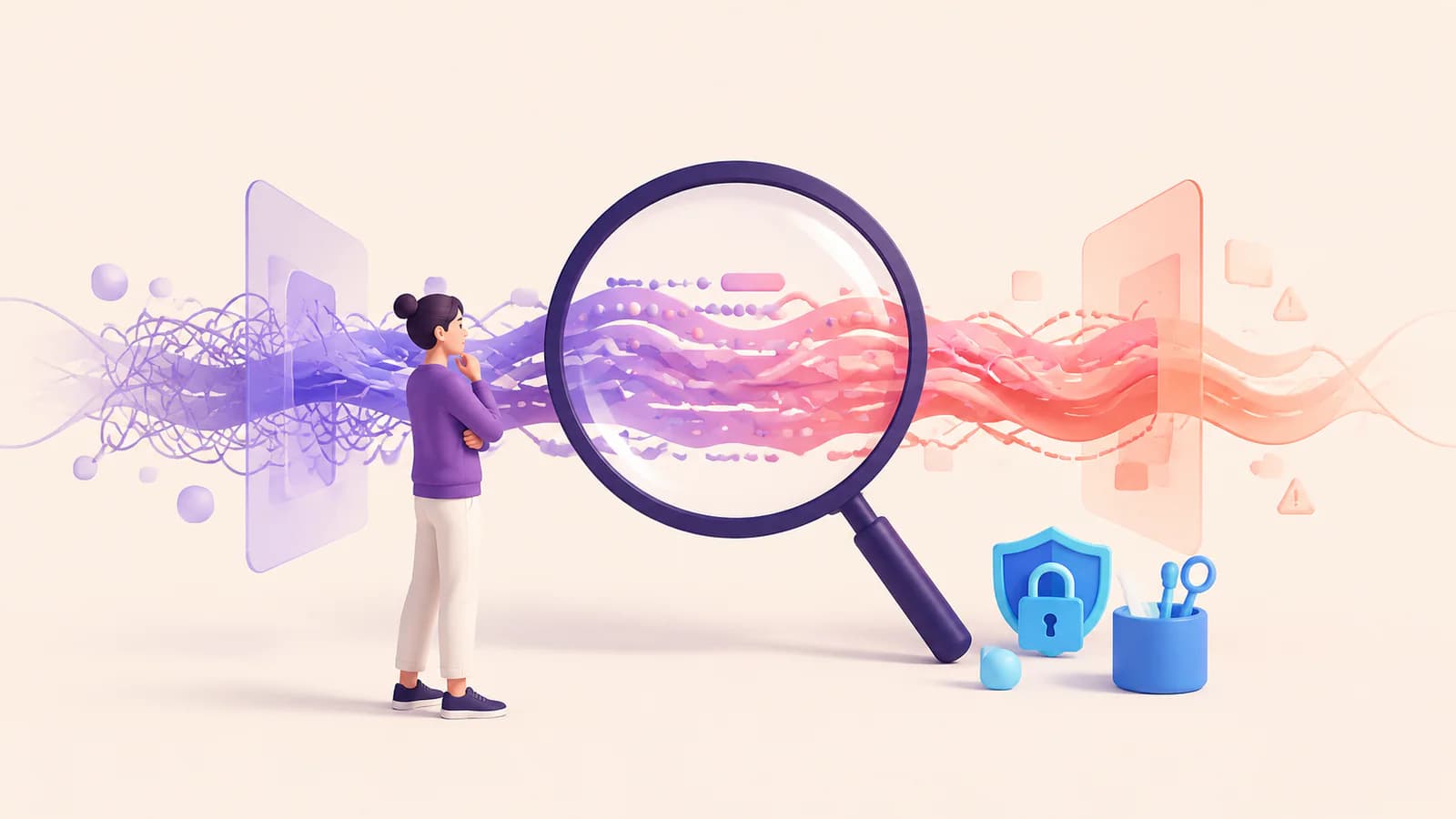
What can AI actually measure in a text conversation?
Quite a lot, as long as it stays with what is countable. A chat export is structured data: timestamps, senders, word counts. From that, an analyzer can reliably measure who starts conversations and how often, how reply times shift over weeks, whether messages are lengthening or shrinking, how questions and future-tense plans are shared between two people, and language patterns researchers have studied for decades. These are the same behaviours relationship science already treats as meaningful — an app that reads your text messages and flags them is, at its best, automating a count you could do by hand with a highlighter and a great deal of patience. For the research behind those signals, see what the research says about texting.
In a 2025 study, more anxiously attached texters used more future-focused language — exactly the kind of measurable language pattern an analyzer can count.
What can no AI know from your texts?
The things that matter most, often. No analyzer can know intent — why a message was short, whether a joke was warm or barbed, what someone meant by a delay. It cannot hear tone of voice, see a face, or know that the two of you had a wonderful afternoon in person the day the texts went quiet. It cannot tell you, with any honesty, whether someone likes you — attraction lives in a whole relationship, not in a message log, so the question “can AI tell if someone likes you from texts” has a hard ceiling no tool clears. This limit has no exceptions, and it applies to ReadBeneath exactly as much as to a general chatbot. A tool can surface a pattern; it cannot read a mind, and any product that claims otherwise is selling certainty the data cannot support.
Why do accuracy claims like '85%' fall apart?
Because “accurate” is meaningless without two missing words: accurate at what, measured against what? A claim like “85% accuracy based on a million conversations” never says whether the tool predicted breakups, matched a therapist’s read, or simply agreed with users who wanted to hear it. Relationship outcomes have no clean answer key — there is no ground truth a chat log can be scored against the way a spam filter can. Worse, large language models tend toward sycophancy: they drift toward the answer you seem to want, which inflates “accuracy” if accuracy just means the user nodded along. So when you are deciding whether relationship analyzer apps are legit, do not ask for a percentage. Ask what was measured — and how anyone could possibly have known the right answer.
How do you judge whether a chat analyzer is any good?
Skip the accuracy number and look at how a tool behaves. Five things separate an honest analyzer from a confident guess, and you can check every one before you upload a thing.
| What to check | Why it matters | How ReadBeneath handles it |
|---|---|---|
| Does it cite the messages? | A claim you can trace to specific messages can be checked; one you can't is just an assertion. | Every observation links to the exact messages behind it. |
| Does it offer a fair alternative? | Every pattern has an innocent reading. A tool that only offers the worrying one is steering you. | A charitable alternative is attached to every finding, by rule. |
| Does it respect sample size? | Ten screenshots can't show a pattern. A tool should say plainly when the sample is too thin. | It skips sensitive findings under 100 messages or 7 days, and holds stronger conclusions back on larger thresholds. |
| Does it cap its own certainty? | Real reads are probabilistic. A number near 100% is a marketing choice, not a measurement. | Confidence is capped at 95%; it never claims to be sure. |
| What happens to your chat? | Private conversations deserve masking, deletion controls, and a stated retention policy. | Personal details are masked before analysis, and you stay in control of your data. |
The same checklist works whether you are weighing a WhatsApp chat analyzer, an Instagram DM analyzer, or a general chatbot — the questions do not change with the platform. The sample-size row has its own deep dive in our sibling post on how many messages reveal a real pattern.
What does an honest analysis actually look like?
Consider the Priya & Marcus sample — a fictional friendship read shaped exactly like a real one. The report notices that Priya asks roughly twice as many follow-up questions as Marcus, and instead of announcing that “Marcus cares less,” it shows the messages, names the pattern as a difference in expressive style, and offers the fair alternative: some people carry warmth in fewer words. When the same report is pushed to say whether Marcus is pulling away, it declines — the thread is warm and consistent, with no shift over time to support that story.
One reading: Counted alone, a two-word reply next to an effusive question looks like a warmth mismatch — one person leaning in, the other holding back.
A fair alternative: But across the whole thread Marcus answers every message, circles back hours later with detail, and starts his own plans. Read against his own baseline, 'went fine' is just how he texts — not a signal of distance. The honest report shows both the question and the pattern around it, and lets you weigh them.
Declining to answer is not a failure. It is the difference between a tool that measures and one that performs — and it is why every finding ships with the evidence, a fair alternative, and a confidence figure that never rounds up to certainty.
Why does your own read still outrank the tool's?
Because you have the context the log will never contain. You know whether the quiet week lined up with a work deadline, whether the sarcasm is your oldest inside joke, whether the person who texts in fragments is the warmest one you know in person. An analysis is at its best when it hands you observations, not conclusions — a clearer picture of what actually happened in the thread, so you can bring it to a real conversation instead of a private spiral. The tool informs the talk; it does not replace it. If a read ever feels truer than your own lived experience of a person, trust yourself and get curious, not certain — that instinct is data too. You can read more about the frameworks and the limits on the methodology page.
Common questions
Can AI detect red flags in text messages?
It can flag observable patterns — a sharp rise in one-sided initiation, reply times that stretch out over weeks, language researchers associate with conflict. What it cannot do is decide those patterns are red flags for you. A pattern is information; whether it is a problem depends on context only you and the other person hold.
Are AI chat analysis apps safe to use?
Safety depends on the tool, not the category. Ask whether it masks personal details before processing, lets you delete your data, and states a retention policy. A general chatbot keeps conversations you paste in; a purpose-built tool should tell you exactly what it stores. Read the privacy page before you upload anything private.
Can an app really tell if someone likes you?
No app can know how someone feels — attraction lives in a whole relationship, not a message log. What a tool can show is behaviour: whether someone initiates, asks questions, and matches your investment consistently over time. Those are real signals worth noticing, but they are evidence for a conversation, not a substitute for one.
How does AI relationship analysis work?
It reads a chat export as structured data — timestamps, senders, word counts — and measures patterns across it: who starts conversations, how reply times change, how language is distributed. Honest tools tie each observation to the specific messages behind it, attach a fair alternative reading, and hold back when the sample is too small to support a conclusion.
How many messages does an AI need to analyze a relationship?
More than a few screenshots. A pattern needs both volume and time — the same behaviour can look cold across ten messages and warm across three weeks. ReadBeneath skips sensitive findings under 100 messages or seven days and holds stronger conclusions back on larger thresholds. Our sibling post on sample size covers the exact numbers.
Keep reading
- How many messages reveal a real pattern?The sample-size answer behind the accuracy question — and the exact thresholds an honest read waits for.
- Should you ask ChatGPT to analyze your texts?The real prompts, the failure modes, and the privacy question worth asking before you paste a private chat anywhere.
- What the research says about textingThe studies behind the signals a tool can measure — and the ones no chat log can settle.
- Analyze a WhatsApp conversationSee the honest version for yourself: cited messages, a fair alternative, and a limit when the sample is short.
Sources
- Gottman, J. M., & Silver, N. (1999). The Seven Principles for Making Marriage Work — the Gottman Institute's Love Lab research on bids for connection and contempt.
- Vanderbilt, R. R., Brinberg, M., & Lu, Y. (2025). The Impact of Attachment Style on Communication Frequency and Language Use in Romantic Partners' Text Messages. Journal of Language and Social Psychology.
- Pew Research Center. Mobile Fact Sheet — texting as the most widely used feature on smartphones.
- ReadBeneath methodology — the sample-size gates, confidence ceiling, and charitable-alternative rule referenced throughout this post.
Judge it against its own checklist
Upload a conversation and get a free read that cites the messages behind every observation, attaches a fair alternative, caps its own confidence, and tells you honestly when the sample is too thin to say. That is the only accuracy claim worth trusting.